
6 OCTOBER 2026 / DEVELOPMENT DEMO
Choose a small pack. Follow it into the reader.
The latest Linux Mint demo brings eight documents into the existing Field Library reader through a selectable test pack. Recommended selection checks the pack, installation verifies its files, and the installed collection becomes available for search and reading. The source is bundled with the demo; customer downloading is still untested.
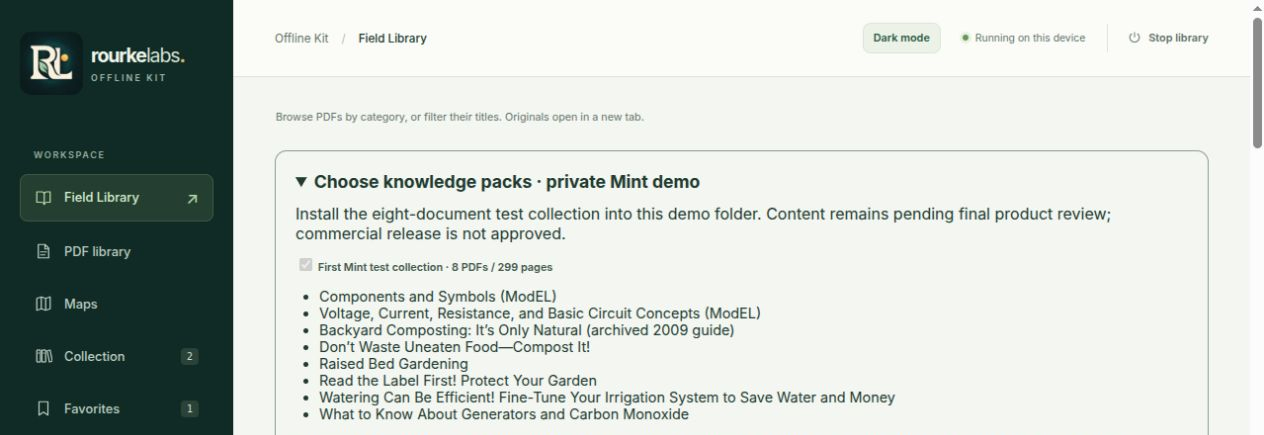
The browser checks exercised selection and installation, a compost search, opening a source passage, and saving a favorite. The PDF catalog showed all eight originals. Existing collection favorites survived, and both old and new favorites reopened after an ordinary process restart.
- 18 installer tests passed, including interrupted setup, damaged files and insufficient-space cases.
- 21 local web checks passed, including all eight original PDF files and partial-file requests.
- 9 existing query regression tests passed.
Visible PDF rendering in a new browser tab still needs checking. Cold startup after a reboot with networking disconnected, a clean customer installation, Windows support and production delivery also remain unverified. These results cover the small development demo.
Keep the three collections clear.
The full review inventory contains 81 PDFs. A separate starter proposal selects 53 of them across five practical-reference packs; that proposal has not been built into a new pack. The working demo uses eight documents, totaling 299 pages. Passing its checks does not qualify the larger collections.
Every inventory item still awaits final product review. Rights evidence, source credits and checksums help prepare that decision, but commercial release is not approved. The next acceptance run needs to follow the whole reading task on the intended Mint setup, with the connection off and the original pages visibly open.
UPDATE / 5 OCTOBER 2026
Preparing a library to share.
A library I use on my own laptop is not automatically a finished bundle for someone else. Preparing a paid edition means deciding exactly what goes in it, how it will be delivered, and which uses the evidence supports.
A focused rights pass on 5 October found stronger, directly readable reuse evidence for a Consumer Product Safety Commission generator-safety guide. That improves the evidence for that guide; it does not approve the whole collection for sale.
Specific decisions remain open: an Aldo Leopold quotation in a USDA soil-health guide, treatment of the USDA mark, and authorization for the National Park Service Arrowhead in a trip guide. The intended distribution territory and product uses also need to be recorded before final inclusion decisions.
The original PDFs remain unchanged. Credits and companion notices help explain the sources, but the review has not resolved every permission question. This is release preparation, not a commercial-clearance finding.
Content review is only one part of the work. The newer package still needs its intended-device, low-memory, connection-off, and customer-delivery checks. Neither the USB kit nor the download is released for sale; Windows compatibility and dependable AI answers remain unverified.
UPDATE / 1 OCTOBER 2026
A larger collection. The original pages still matter.
The current guide review collection contains 81 PDFs, 4,208 physical pages, and 13 categories. That includes short handouts and parts of larger manuals, not 81 complete books. Gardening, food storage, electronics, and outdoor references are among the topics.
Search passages are a way back to the source. The original PDF keeps the diagrams, tables, credits, and surrounding text that a search excerpt can lose. Older reference material stays separate from default search.
A newer Linux development package, version 0.9.0, is prepared. Separate development work has improved index storage and passed bounded automated checks. That does not establish that the new package starts cold on the laptop, fits the finished USB kit, or works on a customer’s computer.
My personal laptop also has U.S. maps downloaded in CoMaps, which I reported working on 29 September. That is a separate device setup, not verification of a map bundle inside Field Library.
What still has to happen.
- Check startup, search, original-document opening, favorites, and restart with networking off on the intended hardware.
- Test low-memory use and moving the library to a different location or computer.
- Finish the exact content inventory, redistribution decisions, notices, and application licensing.
- Qualify the customer package and download process; confirm physical USB fit and use before making a batch.
A separate ten-document rights-review tranche has been prepared, but it is not clearance for the whole collection. Neither the USB kit nor the download is released for sale. Windows compatibility and dependable AI answers remain unverified.
The records below describe the earlier 27–28 September prototype. They remain dated results, not acceptance tests for version 0.9.0.
27–28 SEPTEMBER / EARLIER PROTOTYPE
Make the library easier to use.
The early Field Library interface is working on my Linux Mint laptop. It lets me search saved references and open the source. The two-device photograph shows a seed-saving search beside the phone’s reading library.
The newer development build adds source filters, favorites, dark mode, and a categorized PDF guide browser with links to the original pages. Those additions still need their final checks on the laptop with the connection off.
The first USB prototype.
Two Wikipedia reference archives were copied or reused on the prototype drive and verified against recorded file hashes. A guide pack was also installed and verified.
That confirms the checked files matched their records. The portable reader, startup on another computer, and full drive checks are still unfinished. This is a personal prototype, not a finished USB product for sale.
An answer has to earn its place.
A small local Qwen model was tested with five selected cases and two prompts, giving ten trials. The cases explored using a supplied source, recognizing missing information, and ignoring instructions embedded in source material.
| Check | Recorded result |
|---|---|
| Trials completed | 10 of 10 |
| Required output structure and source-quotation checks | 3 of 10 passed |
| Answer correctness | Not yet reviewed |
These cases were chosen after earlier failures to help improve the implementation. They are a small development test, not a general accuracy benchmark. Passing the format and quotation checks does not prove that an explanation is correct.
The model file was on the USB drive, but the software running it was installed on the laptop. That does not yet make the AI portable. AI answers remain experimental and outside the paid offline setup offer.
Next: prove the everyday use.
The next checks are practical: start with the connection off, find a few useful references, open the original pages, restart, and repeat. A dependable reading library comes first.
The latest update is based on the 6 October eight-document demo report, its actual browser screenshot, and the separate starter-pack inventory review. The earlier results come from my saved prototype copy and verification output, development records, and the 28 September local AI pilot report. The October updates add the 29 September release review, my personal map report, the 1 October tracker and bounded package/rights-review records, and the focused 5 October rights-gap report. The rights records are source reviews; final release decisions remain open. Private paths and machine identifiers are omitted.